
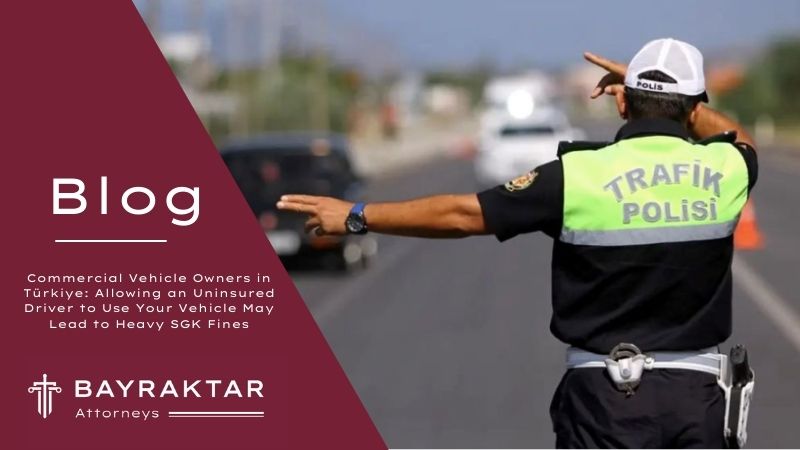
Recent coordination between the Social Security Institution (SGK) and the General Directorate of Security has created significant legal risks for companies owning commercial vehicles in Türkiye.
Traffic inspections no longer result only in standard administrative traffic fines. If a commercial vehicle registered to a legal entity is driven by a person without proper social security registration, the matter is reported to SGK and may trigger substantial administrative penalties.
In some cases, the total financial exposure can approach or exceed 200,000 TRY per driver.
This article explains how the system works, what legal basis applies, and what commercial vehicle owners must do to avoid serious liability.
How the SGK and Police Coordination Works
Since 2021, traffic police conducting roadside inspections check not only driving licenses and vehicle documentation, but also whether the driver of a commercial vehicle is properly registered with SGK.
If:
The vehicle is registered to a company (legal entity), and
The driver is not registered as insured under the social security system,
the situation is formally reported to the Social Security Institution.
The traffic administrative fine report includes:
License plate number
Driver’s Turkish ID number
Name and surname
Location and date of the inspection
Police unit issuing the report
This documentation is transmitted to SGK for further examination.
What Happens After SGK Receives the Report
SGK reviews the file and determines whether the driver was working without insurance registration.
If unregistered employment is confirmed, SGK may:
Retroactively register the employee,
Assess unpaid premiums,
Impose multiple administrative fines on the company.
These penalties are based on Article 102 of Law No. 5510 on Social Insurance and General Health Insurance.
Administrative Fines Under Law No. 5510
If a company is found to have employed an uninsured driver in a commercial vehicle, the following penalties may apply:
Failure to submit the employment entry notification on time:
Two times the monthly minimum wage (approximately 66,060 TRY)Repetition within one year for each uninsured employee:
Five times the monthly minimum wage (approximately 198,180 TRY)Failure to declare the employee in the Monthly Premium and Service Document for each month:
Two times the minimum wage per month (approximately 66,060 TRY)Failure to include the employee in the payroll records per month:
Half of the minimum wage per month (approximately 16,515 TRY)If company records are examined and unregistered work is confirmed for each month:
Additional half minimum wage per month due to invalid records (approximately 16,515 TRY)
When multiple violations accumulate, the total amount can quickly reach very significant levels.
When No Fine Is Imposed
Penalties are generally not imposed if:
The vehicle has been lawfully rented to another real or legal person, and
The driver has been properly insured by the renting party.
In such cases, a written and duly signed rental agreement is essential to demonstrate that the employment relationship does not belong to the vehicle owner.
Without proper documentation, liability may shift back to the registered commercial vehicle owner.
Liability in Case of a Traffic Accident
If an uninsured driver operating a company vehicle is involved in a traffic accident resulting in injury or death, the commercial vehicle owner may face:
Financial liability,
Employer liability claims,
Social security recourse claims,
Potential criminal exposure depending on circumstances.
In practice, the absence of insurance registration significantly increases legal risk.
Key Legal Risk for Companies
Commercial vehicle owners must understand that allowing another person to drive their company vehicle is not merely a traffic matter.
It may constitute:
Unregistered employment,
A social security violation,
A financial and legal exposure that extends far beyond standard traffic fines.
Proper employment registration, payroll compliance, and documentation are essential risk management tools.
Conclusion
Companies owning commercial vehicles in Türkiye should not allow uninsured individuals to operate their vehicles.
Traffic inspections now serve as a gateway for social security enforcement. Administrative fines under Law No. 5510 may reach substantial amounts, and additional liabilities may arise in case of accidents.
Preventive legal compliance is significantly less costly than post-inspection penalties.